
Space Optimization Competition of the European Space Agency
Recently, the fourth Space Optimization Competition (SpOC) organized by the Advanced Concepts Team of the European Space Agency (ESA) ended. It was held at the Genetic and Evolutionary Computation Conference (GECCO’2026) taking place from July 13 to 17, 2026 in San José, Costa Rica. The competition was about applying optimization algorithms to problems from space logistics and space Operations Research. It had three challenges,
- a multi-route logistics problem, where the goal was to discover a set of routes forming a logistics network from Earth orbits to Moon orbits to the Moon surface,
- a single-route logistics problem, where the goal was to find an efficient tour that visits
nsatellites in the moon orbit, and - a tie-breaker challenge, where the goal was to configure a set of spacecraft on certain Moon orbits to form a Morse code message by covering the moonlight.
Each of these challenges involved calculations regarding time, velocity changes, gravity, and orbits using integration of differential equations, trajectory computations, and that alike. Challenge 1 is divided into two types of problems, one (“beginner”) being strictly combinatorial and the other one additionally involving rather complex physics.
Despite having no background at all in any of these topics, we gave this challenge a go as team ScholORs_HFUU+Sunway. We did this mainly for fun and worked together remotely at three different locations, namely at Hefei University (合肥大学), at Sunway University (Malaysia, Sina Abdipoor (سینا عبدیپور)), and BUPT International School, Queen Mary University (Mingxuan LI (李明轩)).
To be honest, the physics behind the challenges were intractable for us. Since each of us is concurrently working on entirely different topics in our research and study areas, we also had limited time to invest into these challenges. Yet, we found them very interesting and wanted to know how far we can get with our ability to work the “optimization aspects” of the challenges but not the “physics aspects”. Space travel, after all, is one of the coolest things (not) on earth.
In the end, we arrived at the 9th place, which is not very good. Then again, we found feasible and not-too-bad solutions for every single challenge and problem instance. For most of the tasks, the vast majority of solutions are infeasible. Plugging the objective function into an optimization algorithm with the hope that the algorithm will sort it out and discover feasible solutions eventually is not going to work.
Surprisingly, for several of the challenges, we were the first team that found any solution.
We even managed to hold rank 1 on several challenges and probably overall for several weeks, too.
For participating just for fun, I think that’s not bad.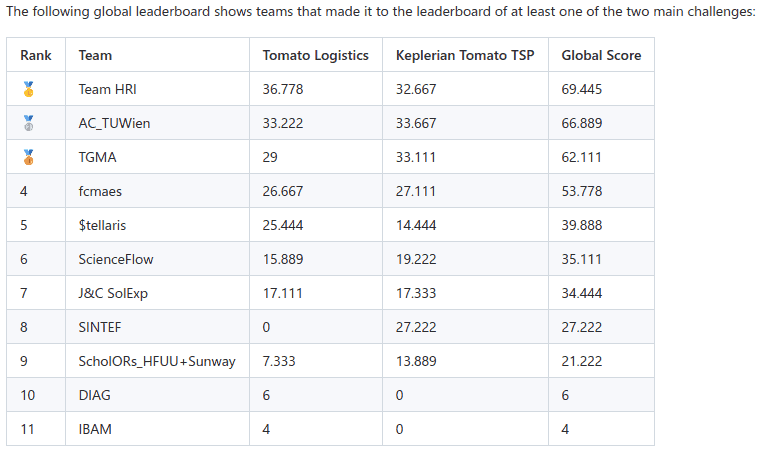
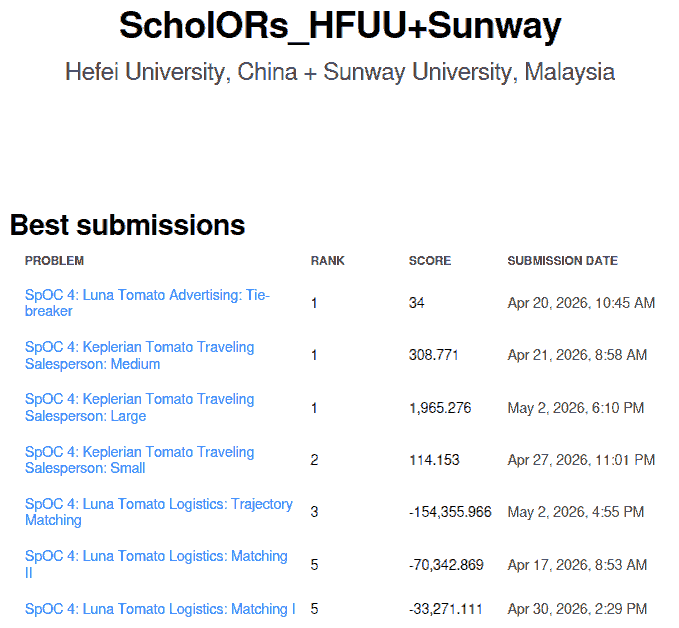
For most of the tasks, we used simple local searches like RLS and Simulated Annealing with some special encodings and preprocessing. The reason is that the objective function (FEs) evaluations here were very costly, often involving integration of differential equation or otherwise “simulating” trajectories. Without better Maths and Physics understanding, there was no way around paying this cost — and this probably was one of the factors limiting our success. Anyway, if only few FEs can be done, then it is best to spend them on strict local search. Combining this approach with some preprocessing, we could find a feasible solution within only 187 seconds for the largest instance of the second challenge on an off-the-shelf laptop computer, for example. We describe our methods for three of the four problem types in two short papers:
- Mingxuan LI (李明轩), Thomas Weise (汤卫思), Sina Abdipoor (سینا عبدیپور), Jourdan D'orville, Say Leng Goh, Razali Yaakob, and Salwani Abdullah: Integrative Hybrid Local Search with Luby's Restart Strategy for University Course Timetabling with Student Sectioning. 15th Conference on the Practice and Theory of Automated Timetabling (PATAT'2026), August 25-28, 2026, University of Nottingham, UK. UK/Belgium: EURO Working Group on Automated Timetabling (EWG-PATAT), part of Fribourg, Switzerland: Association of European Operational Research Societies (EURO).
- Thomas Weise (汤卫思), Sina Abdipoor (سینا عبدیپور), Mingxuan LI (李明轩), and Zhize WU (吴志泽): Solving the SpOC 4 Challenge 2 with a Multi-Step Permutation Encoding for the Keplerian Traveling Salesperson. Genetic and Evolutionary Computation Conference (GECCO'2026) Companion, July 13-17, 2026, San José, Costa Rica, pages 33–34. New York, NY, USA: ACM.
We enjoyed participating in this challenge very much. Despite not understanding (and not having the spare time to really dig into) the astrophysics governing them, we solved all challenges. This shows how versatile skills in optimization, operations research, and metaheuristic optimization are. If you study this topic, you will be able to work in almost any field of research, engineering, or management and make valuable contributions, which will get better and better the more you understand about your field…